

Controlling the brightness of a 5mm Dip LED is a fundamental skill that can be useful in a wide range of applications, from simple DIY projects to more complex electronic systems. As a 5mm Dip LED supplier, I have seen firsthand the importance of understanding how to manage LED brightness effectively. In this blog post, I will share some practical methods and considerations for controlling the brightness of these versatile components.
Understanding the Basics of 5mm Dip LEDs
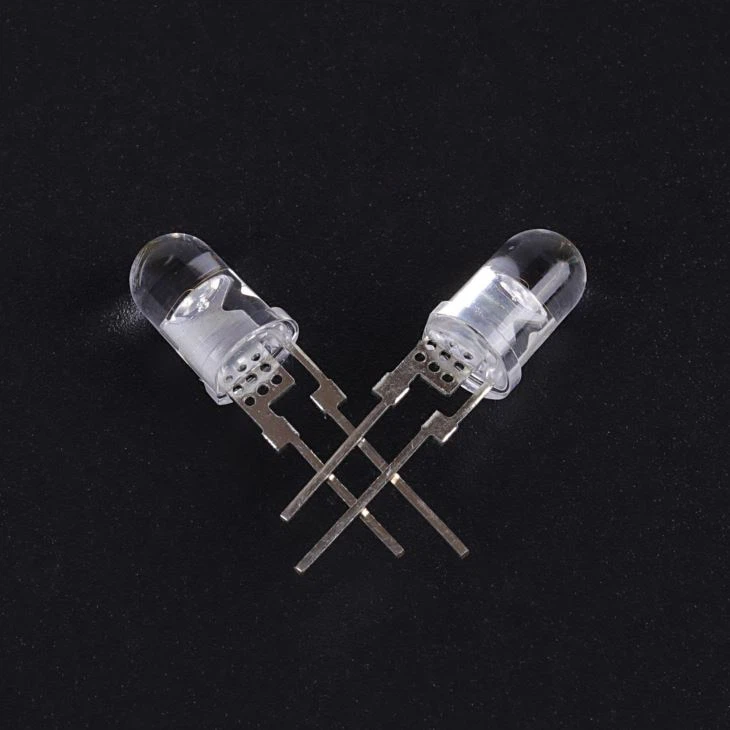
Before diving into the methods of brightness control, it's essential to have a basic understanding of 5mm Dip LEDs. These LEDs are a type of through - hole LED, which means they are designed to be inserted through holes in a printed circuit board (PCB). The "5mm" refers to the diameter of the LED package, and they are available in various colors, including red, green, blue, and white.
One of the key characteristics of an LED is its forward voltage (Vf) and forward current (If). The forward voltage is the voltage required to turn on the LED, and the forward current is the current that flows through the LED when it is on. For most 5mm Dip LEDs, the forward voltage ranges from about 1.8V to 3.6V, depending on the color, and the typical forward current is around 20mA.
Method 1: Using a Resistor
The simplest way to control the brightness of a 5mm Dip LED is by using a resistor. According to Ohm's Law (V = IR), where V is the voltage, I is the current, and R is the resistance, we can calculate the appropriate resistor value to limit the current flowing through the LED.
The formula to calculate the resistor value is: [R=\frac{V_{supply}-V_{f}}{I_{f}}]
For example, if you have a 5V power supply, a red LED with a forward voltage of 2V, and you want a forward current of 10mA (0.01A), the resistor value would be: [R=\frac{5 - 2}{0.01}=300\Omega]
By increasing the resistor value, you can reduce the current flowing through the LED, which in turn decreases its brightness. However, this method has its limitations. Once you set the resistor value, the brightness of the LED is fixed, and it cannot be easily adjusted.
Method 2: Pulse Width Modulation (PWM)
Pulse Width Modulation is a more advanced and flexible method for controlling the brightness of a 5mm Dip LED. PWM works by rapidly turning the LED on and off at a high frequency. The perceived brightness of the LED is determined by the duty cycle, which is the ratio of the time the LED is on to the total time of one cycle.
For example, if the duty cycle is 50%, the LED is on for half of the time and off for the other half. The human eye cannot perceive the rapid on - off switching at high frequencies (usually above 100Hz), so the LED appears to have a lower brightness.
To implement PWM, you typically need a microcontroller, such as an Arduino. The microcontroller can generate a PWM signal with a variable duty cycle. You can use the analogWrite() function in Arduino to control the duty cycle of the PWM signal.

```cpp int ledPin = 9;
void setup() { pinMode(ledPin, OUTPUT); }
void loop() { for (int brightness = 0; brightness <= 255; brightness++) { analogWrite(ledPin, brightness); delay(10); } for (int brightness = 255; brightness >= 0; brightness--) { analogWrite(ledPin, brightness); delay(10); } } ```
In this code, the LED brightness gradually increases and then decreases. The analogWrite() function takes a value between 0 and 255, where 0 means the LED is off (0% duty cycle) and 255 means the LED is fully on (100% duty cycle).
Method 3: Using a Potentiometer
A potentiometer is a variable resistor that can be used to control the brightness of a 5mm Dip LED. By adjusting the potentiometer, you can change the resistance in the circuit, which in turn changes the current flowing through the LED.
To use a potentiometer, connect one end of the potentiometer to the power supply, the other end to ground, and the wiper (the middle terminal) to the resistor - LED circuit. As you turn the potentiometer, the resistance between the wiper and the power supply or ground changes, altering the voltage across the resistor and the current through the LED.
However, it's important to note that the potentiometer should be rated to handle the power dissipated in the circuit. Otherwise, it may overheat and fail.

Considerations for Brightness Control
When controlling the brightness of a 5mm Dip LED, there are several factors to consider:
- Color Temperature: Different colors of LEDs have different forward voltages and characteristics. For example, blue and white LEDs generally have a higher forward voltage than red and green LEDs. This means that the resistor values and control methods may need to be adjusted accordingly.
- Power Dissipation: LEDs generate heat when current flows through them. If the LED is operated at a high current for an extended period, it may overheat, which can reduce its lifespan and affect its performance. Therefore, it's important to ensure that the LED is within its specified current and power ratings.
- Viewing Angle: The viewing angle of a 5mm Dip LED can also affect the perceived brightness. LEDs with a wider viewing angle may appear less bright when viewed from a direct angle compared to LEDs with a narrower viewing angle.
Our Product Offerings
As a 5mm Dip LED supplier, we offer a wide range of high - quality products. Our High Power LED 5mm 0.5W is suitable for applications that require higher brightness. It has a power rating of 0.5W, which allows it to emit more light compared to standard 5mm Dip LEDs.
We also have 4mm White Led in our product line. Although it has a smaller diameter than the 5mm LEDs, it still provides a bright and clear white light, which is ideal for applications where space is limited.
Another popular product is our 5mm 12V DC White Led. This LED is designed to operate directly from a 12V DC power supply, which simplifies the circuit design and makes it easy to integrate into various systems.
Contact Us for Purchase and Negotiation
If you are interested in purchasing our 5mm Dip LEDs or have any questions about brightness control or other technical aspects, we encourage you to contact us. Our team of experts is ready to provide you with detailed product information, technical support, and competitive pricing. We look forward to working with you to meet your LED needs.

References
- Horowitz, P., & Hill, W. (1989). The Art of Electronics. Cambridge University Press.
- Arduino Documentation. (n.d.). Retrieved from https://www.arduino.cc/en/Reference/HomePage