

Hey there! As a supplier of 0603 Ir Led, I've had my fair share of experiences with these little components. Today, I wanna talk about how to regulate the current of 0603 Ir Led. It's a crucial aspect that can significantly impact the performance and lifespan of these LEDs.
First off, let's understand why current regulation is so important. 0603 Ir Leds are designed to operate within a specific current range. If the current is too high, it can cause excessive heat, which not only shortens the lifespan of the LED but can also lead to a decrease in its efficiency. On the other hand, if the current is too low, the LED may not emit the desired amount of infrared light.
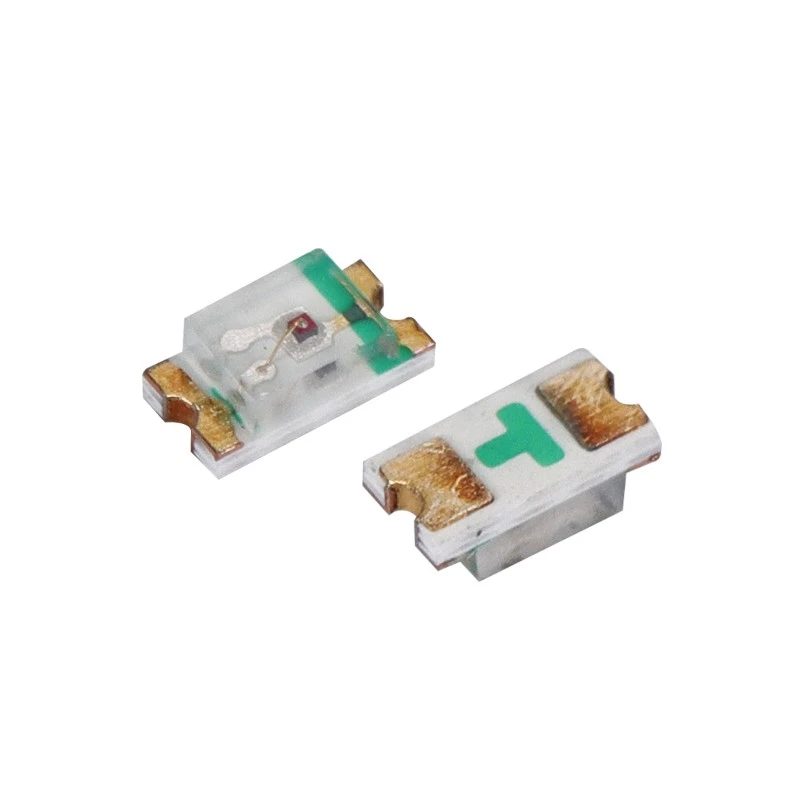
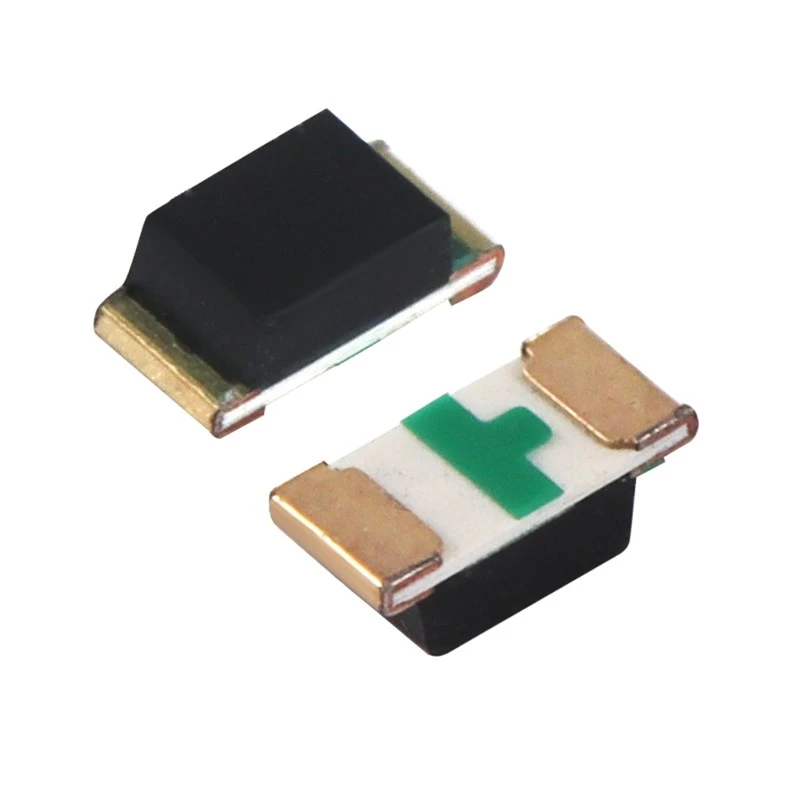
So, how do we go about regulating the current? One of the most common methods is using a resistor. Resistors are simple and cost - effective components that can be used to limit the current flowing through the 0603 Ir Led. To calculate the value of the resistor, we need to know a few things: the supply voltage, the forward voltage of the 0603 Ir Led, and the desired operating current.
The forward voltage of a 0603 Ir Led typically ranges from around 1.2V to 1.5V, depending on the specific model. Let's say we have a supply voltage of 5V and we want the LED to operate at a current of 20mA (0.02A). The formula to calculate the resistor value is (R=\frac{V_{supply}-V_{forward}}{I}), where (V_{supply}) is the supply voltage, (V_{forward}) is the forward voltage of the LED, and (I) is the desired current.
If we assume a forward voltage of 1.2V, then (R=\frac{5 - 1.2}{0.02}=\frac{3.8}{0.02}=190\Omega). In practice, we might choose a standard resistor value close to 190Ω, like 200Ω.
Another method for current regulation is using a constant - current source. A constant - current source is a circuit that maintains a constant current regardless of the load resistance or the supply voltage variations. This is a more precise way of regulating the current, especially in applications where a very stable current is required.
There are different types of constant - current sources. One simple type is based on a bipolar junction transistor (BJT). The BJT can be configured in a way that it regulates the current flowing through the 0603 Ir Led. For example, a common - emitter configuration with a resistor in the emitter can be used to set the current.
We can also use integrated circuits (ICs) designed specifically for current regulation. These ICs are often more accurate and reliable than discrete components. They can provide a very stable current output and are easy to use in a circuit.
Now, let's talk about the impact of temperature on current regulation. The forward voltage of 0603 Ir Leds changes with temperature. As the temperature increases, the forward voltage decreases. This means that if we are using a simple resistor for current regulation, the current through the LED will increase as the temperature rises. To compensate for this, we can use a thermistor in the circuit. A thermistor is a resistor whose resistance changes with temperature. By placing a thermistor in series or parallel with the current - limiting resistor, we can adjust the resistance of the circuit as the temperature changes, thereby maintaining a more stable current.
When it comes to choosing the right current for your 0603 Ir Led, it depends on your specific application. If you're using the LED for a short - range infrared communication, a relatively low current might be sufficient. However, if you're using it for a long - range infrared sensing or illumination, you may need a higher current to get the desired output.
It's also important to note that different 0603 Ir Leds may have different maximum current ratings. Always check the datasheet of the LED to ensure that you're not exceeding its maximum current. Exceeding the maximum current can damage the LED and void its warranty.
If you're looking for other types of infrared LEDs, we also offer a variety of products. For instance, we have the 0805 Infrared Chip Led, which is a great option for applications that require a slightly larger size. The SMD 2835 30° IR Emitter LED is another popular choice, known for its good beam angle and high efficiency.
We also have the 3W Infrared Led, which is suitable for high - power applications. The 1206 IR Infrared LED offers different wavelengths and is a reliable option for many infrared projects. And don't forget about the 3535 IR LED, which has its own unique features and advantages.
If you're interested in our 0603 Ir Leds or any of our other products, we're here to help. Whether you have questions about current regulation, need advice on choosing the right LED for your application, or are ready to place an order, feel free to reach out. We're always happy to have a chat and discuss your requirements.
In conclusion, regulating the current of 0603 Ir Leds is an important step in ensuring their optimal performance and longevity. Whether you choose to use a simple resistor or a more sophisticated constant - current source, understanding the principles of current regulation is key. And if you need any assistance or want to explore our range of infrared LEDs, don't hesitate to contact us for a procurement discussion.
References:
- General knowledge of LED electronics and component datasheets.
- Textbooks on basic electronics and circuit design.