

The beam pattern of an LED, especially for SMD (Surface Mount Device) 0603 LED, is a crucial characteristic that significantly impacts its performance and application suitability. As an SMD 0603 LED supplier, understanding the beam pattern is essential for both us and our customers to make informed decisions about which LEDs are best for specific projects.
Understanding Beam Patterns
The beam pattern of an LED refers to the way light is distributed in space when emitted from the LED. It is typically represented graphically through polar plots or candela distribution curves. These visual representations help users understand how the light intensity varies at different angles from the LED's optical axis.
There are several common types of beam patterns, including:
- Lambertian Pattern: This is the most common beam pattern for LEDs. In a Lambertian pattern, the light intensity follows a cosine distribution, meaning the intensity is highest at the center (0° angle) and decreases as the angle increases from the optical axis. SMD 0603 LEDs often exhibit a near - Lambertian pattern due to their small size and the nature of the semiconductor materials used. The advantage of the Lambertian pattern is that it provides a wide - spread, uniform illumination, making it suitable for general lighting applications such as backlighting for displays, indicator lights, and decorative lighting.
- Narrow Beam Pattern: Some SMD 0603 LEDs can be designed to have a narrow beam pattern. This is achieved through the use of special lenses or reflectors. Narrow beam LEDs have a high light intensity concentrated in a small angular range. They are ideal for applications where long - distance illumination or focused light is required, such as in optical communication systems or in sensors that rely on a precise beam of light.
- Wide Beam Pattern: Wider than the standard Lambertian pattern, wide - beam SMD 0603 LEDs are designed to cover a larger angular area. They are useful in applications where a broad - area illumination is needed with relatively low light intensity, such as in some types of signage or mood lighting.
Factors Affecting the Beam Pattern of SMD 0603 LEDs
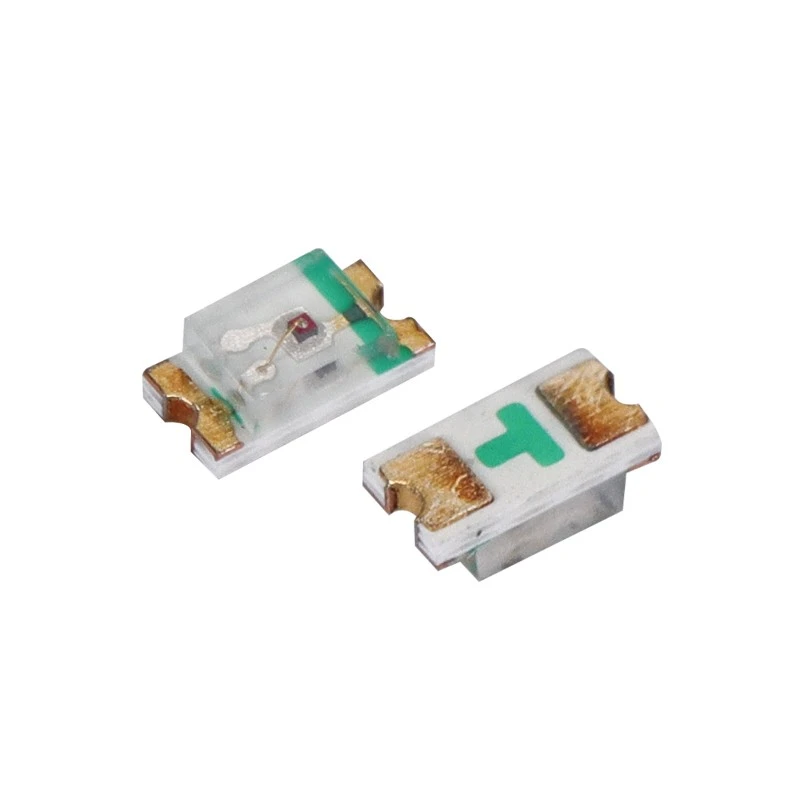
- Package Design: The physical structure of the SMD 0603 LED package plays a significant role in determining the beam pattern. The shape and material of the encapsulant, as well as the placement of the LED die within the package, can influence how light is refracted and scattered. For example, a flat - topped encapsulant may result in a more Lambertian beam pattern, while a domed encapsulant can change the light distribution, potentially narrowing or widening the beam.
- Die Size and Placement: The size of the LED die and its position within the SMD 0603 package can also affect the beam pattern. A larger die may emit more light, but the way it is centered or misaligned within the package can cause variations in the light distribution. If the die is off - center, it may lead to an asymmetrical beam pattern.
- Lens or Optics: Adding external lenses or optical elements to the SMD 0603 LED can modify the beam pattern. A simple plano - convex lens can focus the light, creating a narrower beam, while a diffuser can spread the light, resulting in a wider beam pattern.
Applications Based on Beam Patterns
- General Lighting: For general lighting applications like backlighting for LCD screens or small - scale indoor lighting fixtures, SMD 0603 LEDs with a Lambertian or wide - beam pattern are preferred. The White 0603 LED is a popular choice in such scenarios as it can provide a soft, uniform illumination over a wide area.
- Indicator Lights: In electronic devices where indicator lights are used to show the status of a component, the beam pattern can be adjusted according to the visibility requirements. A narrow - beam LED like the Red SMD 0603 LED can be used when the light needs to be clearly visible from a specific direction, while a wide - beam LED may be suitable for applications where the indicator should be visible from multiple angles.
- Decorative Lighting: Decorative lighting often requires unique and creative lighting effects. SMD 0603 LEDs with different beam patterns can be combined to create interesting visual displays. For example, using a combination of wide - beam SMD 0603 Blue LED and narrow - beam SMD 0603 Green LED can produce a captivating lighting arrangement.
- Sensors and Detection: In optical sensors and detection systems, the beam pattern of the LED is critical. A narrow - beam LED, such as the 0603 Purple Led, can be used to emit a focused beam of light that can be accurately detected by a photodetector, enabling precise measurements or object detection.
Measuring and Specifying Beam Patterns
To accurately communicate the beam pattern of SMD 0603 LEDs to customers, standardized measurement methods are used. The most common measurement is the viewing angle, which is defined as the angle at which the light intensity drops to 50% of the maximum intensity on the optical axis. For example, an LED with a viewing angle of 120° has a relatively wide beam pattern, while one with a 30° viewing angle has a narrow beam.
Manufacturers also provide candela distribution curves or polar plots in the product datasheets. These graphical representations show the light intensity distribution in all directions around the LED. By analyzing these curves, customers can understand exactly how the light will be distributed in their specific applications.
Our Role as a Supplier
As an SMD 0603 LED supplier, we are committed to providing high - quality LEDs with well - defined beam patterns. We ensure that our manufacturing processes are precise to produce LEDs with consistent beam characteristics. Our technical team is always available to help customers select the right LED based on their beam pattern requirements.
We work closely with our customers to understand their application needs. Whether it is a large - scale lighting project or a small - scale electronic device, we can provide customized solutions. If a customer requires a specific beam pattern that is not currently in our standard product range, we can collaborate with them to develop a custom - designed LED.
Contact Us for Purchase
We invite you to contact us to discuss your SMD 0603 LED requirements. Our team of experts can provide detailed information about the beam patterns of our products, assist you in product selection, and offer competitive pricing. We are dedicated to delivering the best LED solutions for your projects.
References
- Nickolas, J. (2015). Understanding LED Beam Patterns. Lighting Technology Journal.
- Smith, A. (2017). The Impact of Package Design on LED Beam Patterns. Semiconductor Science Review.
- Johnson, P. (2019). Applications of Diverse LED Beam Patterns. Electronic Applications Magazine.